Urban Drifters: Self-Driving Scooter
3D Prototyping & Interaction Design
Overview
A human-centered interaction design project exploring how semi-autonomous technology can support safer, more intuitive urban scooter experiences. This project focuses on designing an integrated physical and digital control system for a Level 2 semi-autonomous electric scooter, intended for leisure urban exploration. By combining interaction design principles, user research, and physical prototyping, the solution prioritizes low cognitive load and improving rider confidence; especially during high-risk moments such as navigation, stopping, and mode transitions.
Demo Video
Problem Statement
Urban electric scooters are increasingly used for short, exploratory trips in dense city environments, yet many existing designs prioritize efficiency and minimal hardware over rider safety, comfort, and clarity. Riders must constantly divide attention between traffic, navigation, and scooter controls, leading to confusion during critical moments like braking, signaling, or switching modes. These challenges are amplified for riders navigating unfamiliar areas, where poor control discoverability, unclear feedback, and high cognitive load increase stress and risk. There is a need for a semi-autonomous scooter that meaningfully assists riders; particularly with navigation and transitional moments; while remaining intuitive, transparent, and easy to override.
Objective
To design and prototype a semi-autonomous electric scooter control system that supports safe, low-friction urban exploration. The project aims to create an intuitive physical and digital interface that reduces cognitive load, improves control discoverability, and clearly communicates system state. Through iterative user research, interaction design, and physical prototyping, the solution balances rider autonomy with assistive features, ensuring users feel informed, in control, and confident throughout their ride.
Role
Interaction Designer
Lead Prototyper
Tools Used
Figma
Microsoft Visio
Fig Jam
Duration
October 2025 - December 2025
Our Process
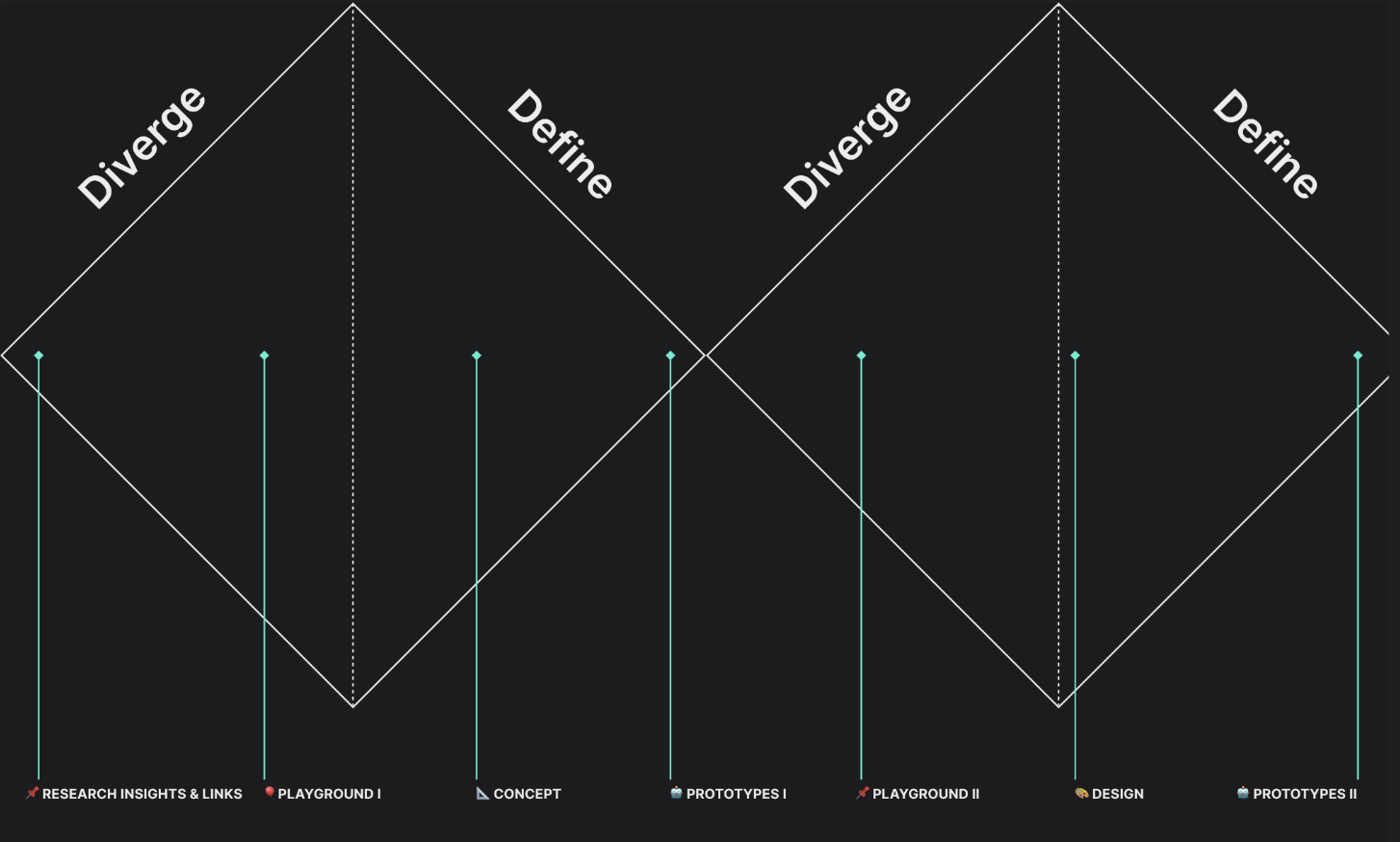
We applied a Double Diamond framework to design intuitive controls for a semi-autonomous scooter. The first diamond focused on research and concept development; the second on prototyping, visual design, and validation through user testing.
User Persona
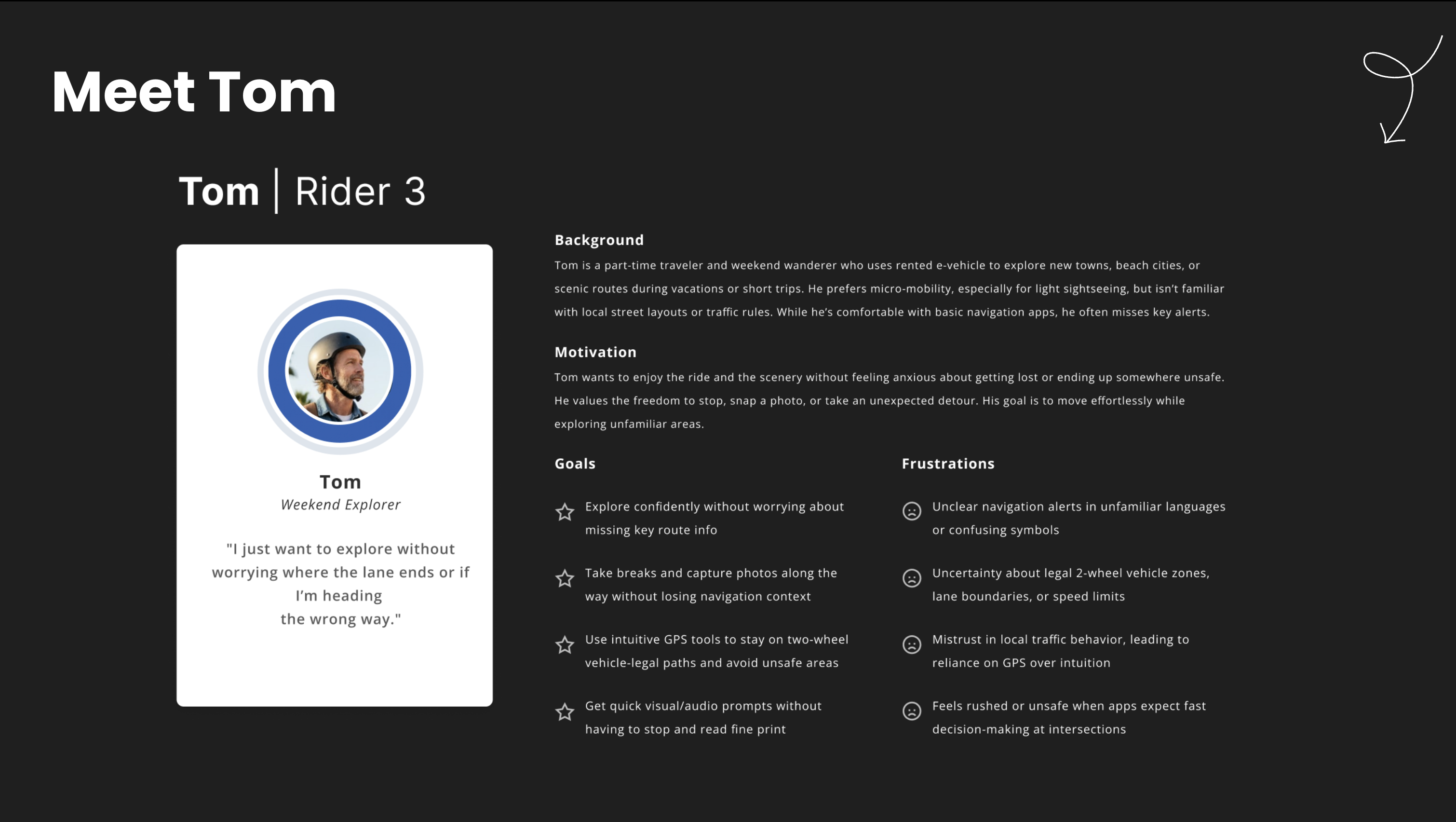
Within the scope of the assignment, our team selected one persona from a predefined set of six. We intentionally chose a persona that none of us personally identified with, allowing us to practice designing for others rather than defaulting to our own preferences or assumptions. This decision pushed us to rely more heavily on research, observation, and user feedback, ensuring that our design choices were grounded in real user needs. By distancing ourselves from personal bias, we were able to focus on creating features that were not just novel or interesting to us, but genuinely productive, efficient, and supportive of the rider's experience.
Primary Research
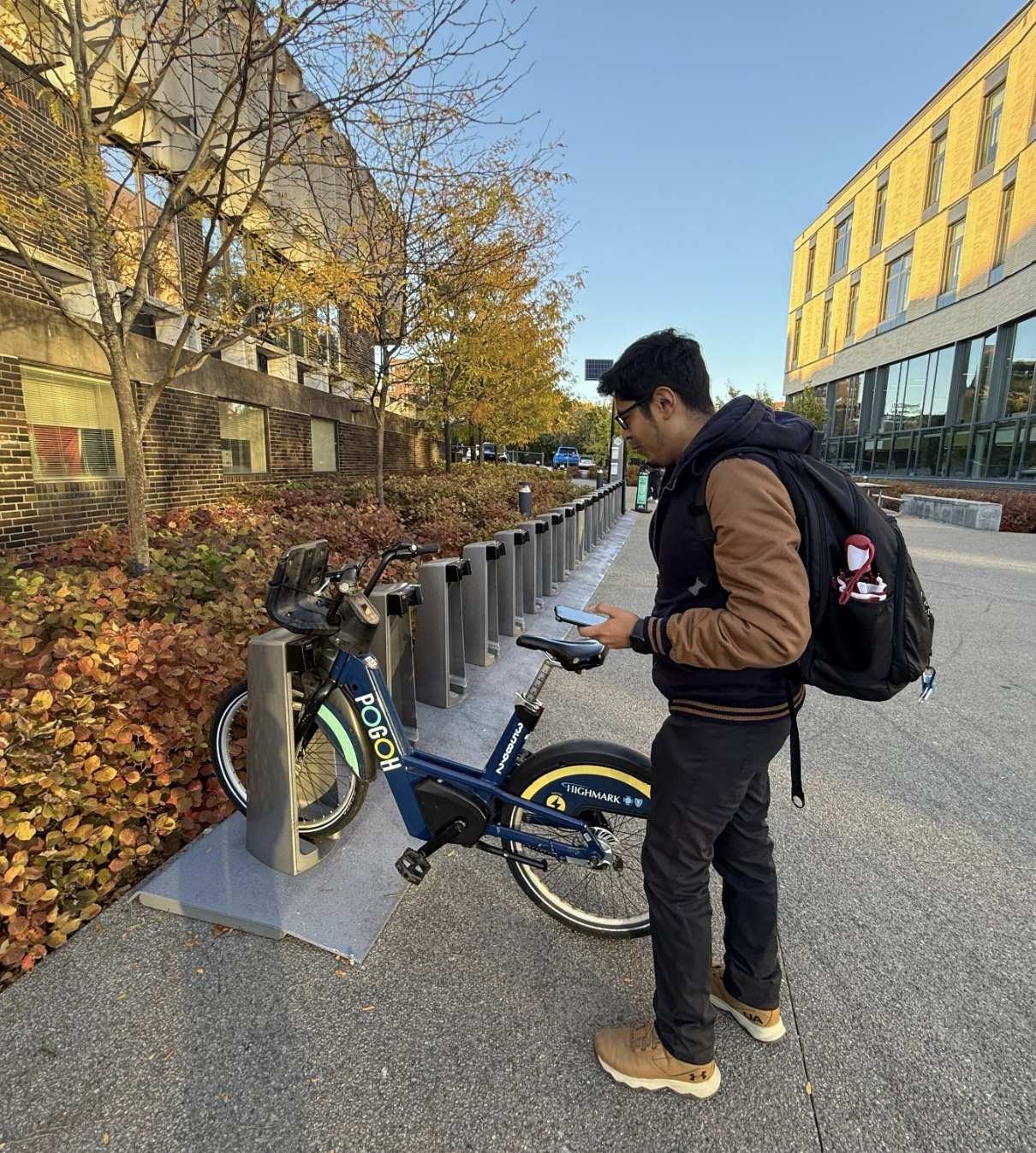
We conducted 6 guerrilla interviews near CMU's campus (407 S Craig St) to understand real rider experiences.
"It's just not safe to ride next to cars because they drive really close to me."
"In the winter, it's rough as a scooter rider. The battery dies fast and the tires get packed with snow."
"I look at the directions before riding and just look at street names to find my way."
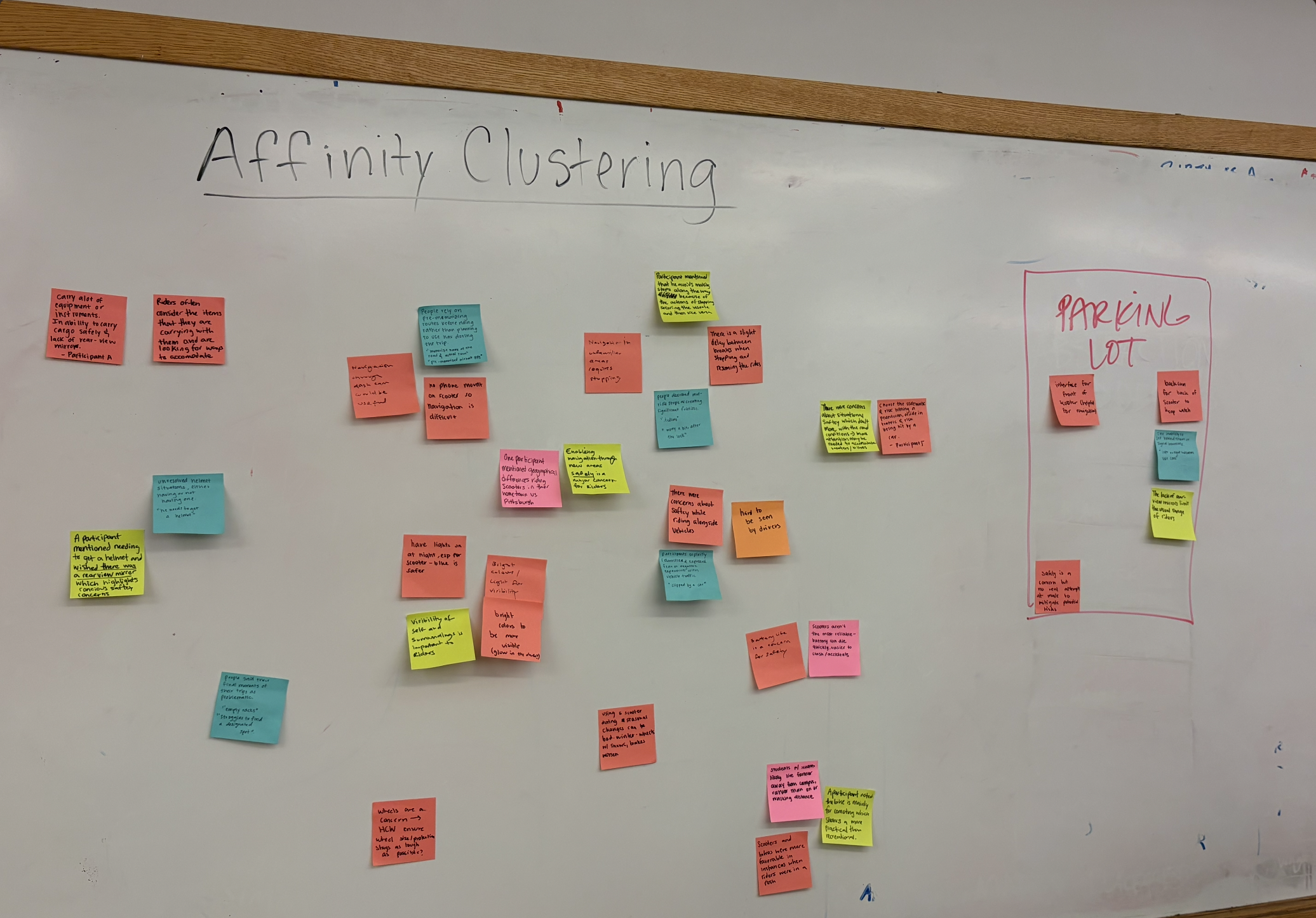
Affinity Clustering
From our interviews, we grouped findings to identify recurring themes and patterns.
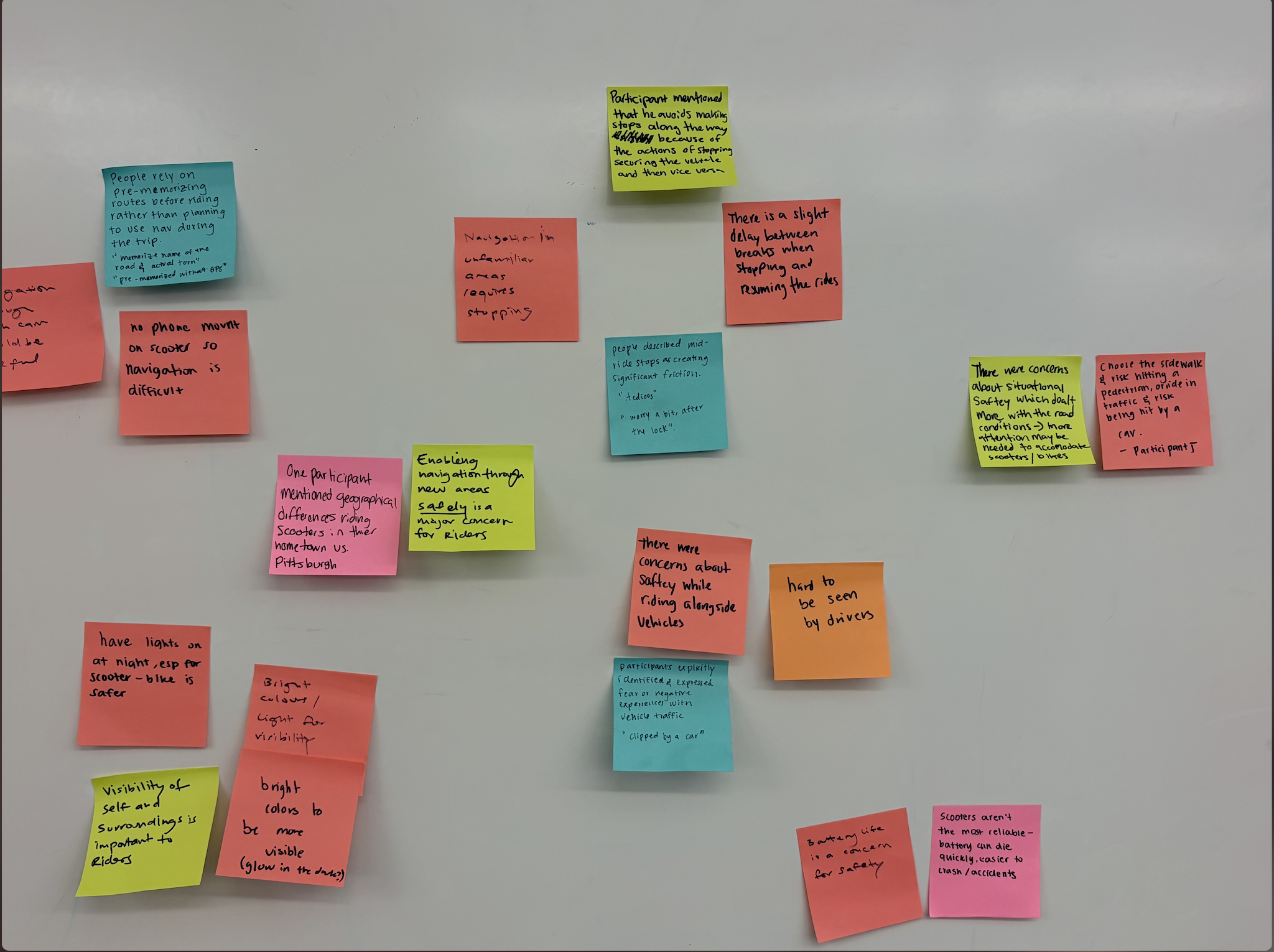
Key Insights
From our clusters, we distilled five insights to guide our design direction.
Transitions feel risky
Scooter users feel most uncertain during transitional moments such as stopping, braking, and navigating around others on the road.
Visibility goes both ways
Visibility is a major concern for riders, both being able to be seen by others and being able to see their surroundings.
Navigation creates friction
While navigating, scooter users find that there is a lack of convenient and safe ways to view directions which creates unnecessary friction and distraction in an otherwise smooth biking experience.
Endings are stressful
Trip termination consistently generates maximum stress, with parking and security concerns overshadowing the entire preceding ride experience.
Riders are predictable
People are consistent in their reasons for riding a scooter and follow similar riding patterns.
How might we…
From our clusters & insights, we generated 11 questions to reframe challenges into opportunities.
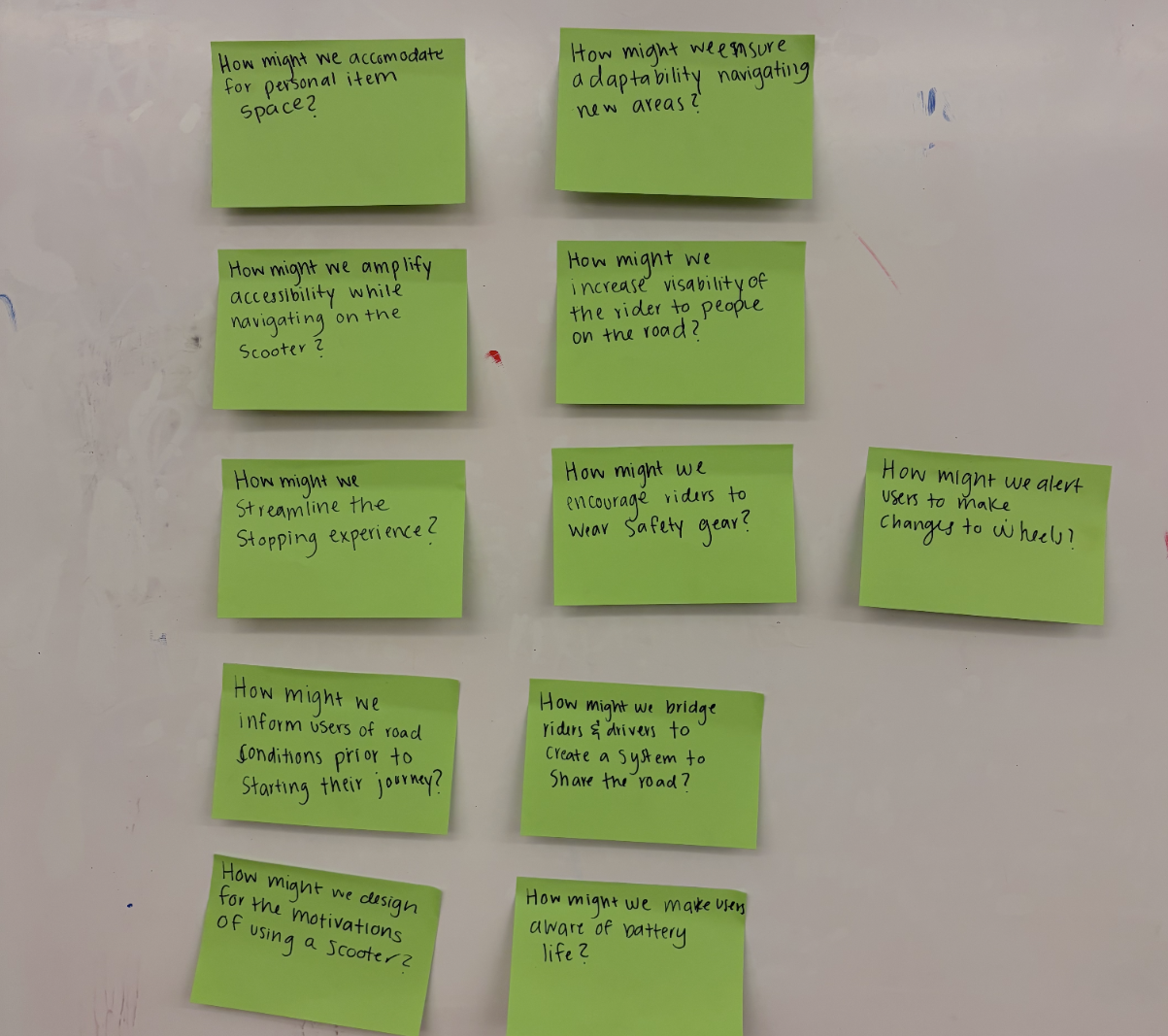
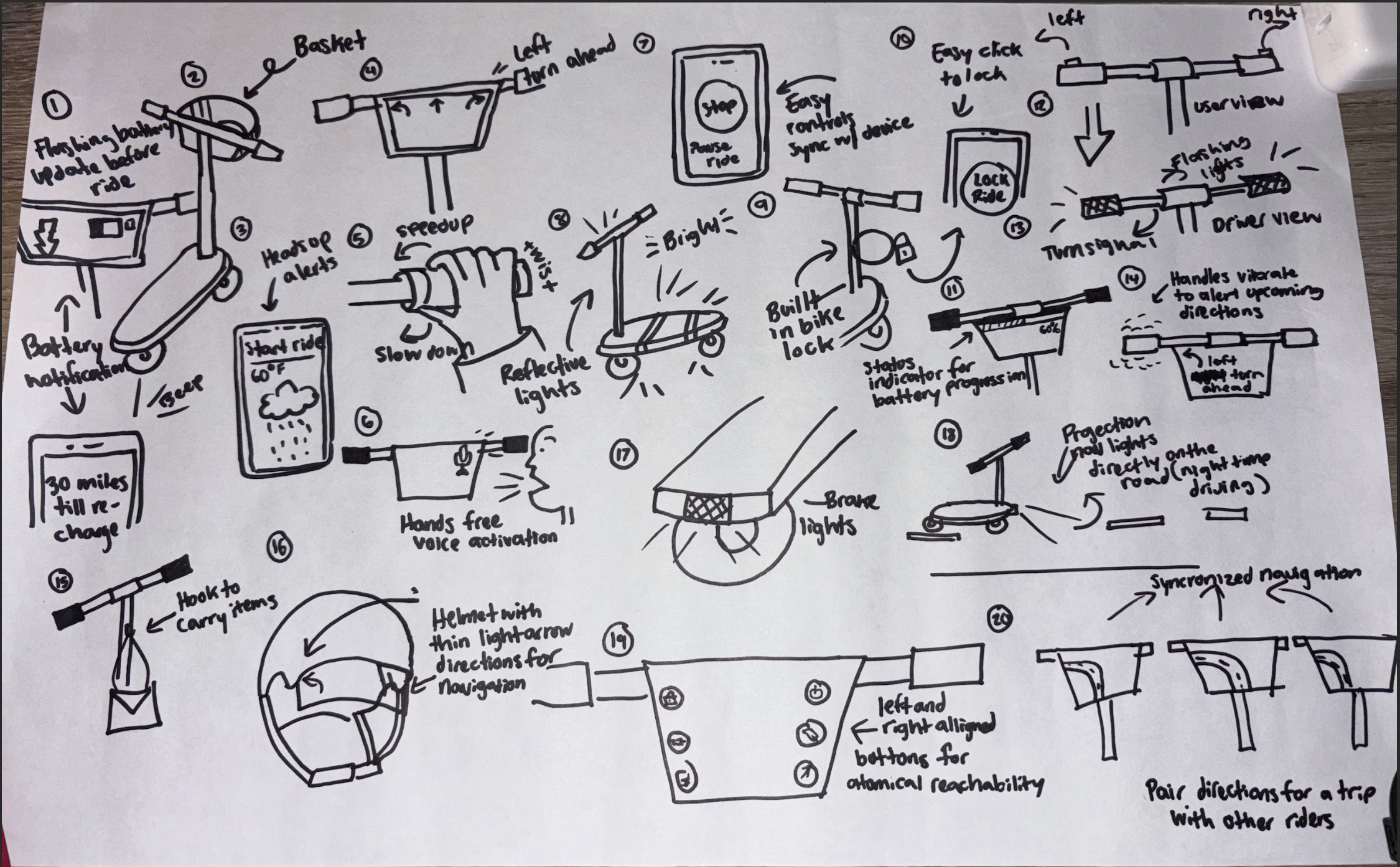
Concept Sketches
Each teammate produced over 20 concept sketches exploring potential features and interaction patterns that could address the identified pain points.
Concept Synthesis
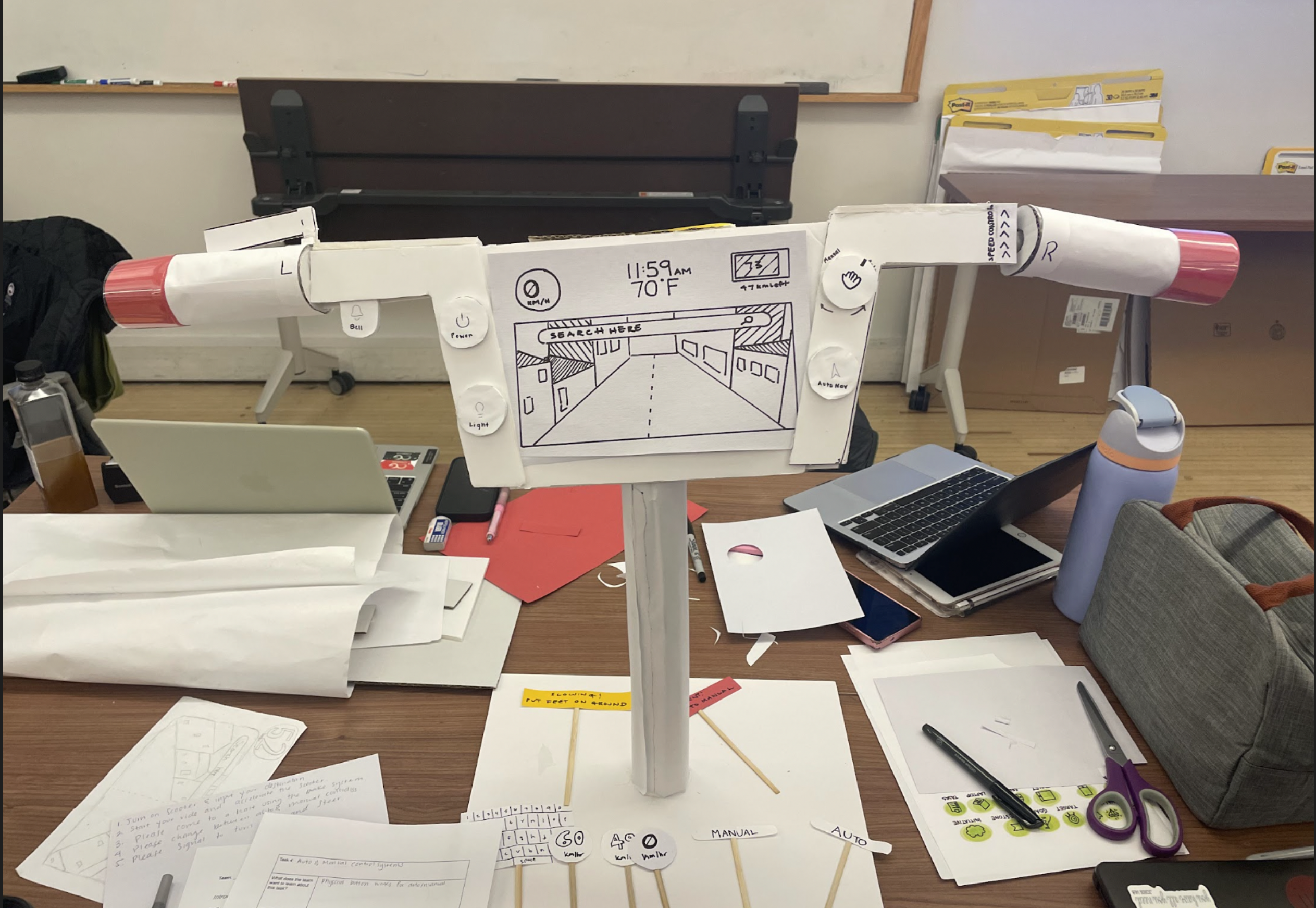
We mapped our best ideas onto the scooter, organizing them into physical additions (auto-manual button, lights, and brakes) and digital additions (turn signals, road condition sensors, voice activation, tilted navigation).
Think Aloud Testing
We conducted user testing sessions to observe how they naturally interacted with our scooter prototype and identify usability issues.
Tasks completed:
- Explore the Scooter & Power On
- Starting Ride of Scooter and Accelerating
- Braking System of the Scooter
- Auto & Manual Control Systems
- Turning Right and Signaling
Process description:
During our think-aloud testing study, we gathered six participants and asked them to complete a series of five tasks. During these tasks, we did not intervene or provide any assistance; rather, we observed the participants' natural instincts and perceived observations. While doing so, we recorded the test sessions and had two note-takers; one capturing what the participant said, and the other documenting the participant's actions and body language. This gave us a holistic view of how users expected to interact with our scooter design, as well as the hesitations and pain points they encountered.
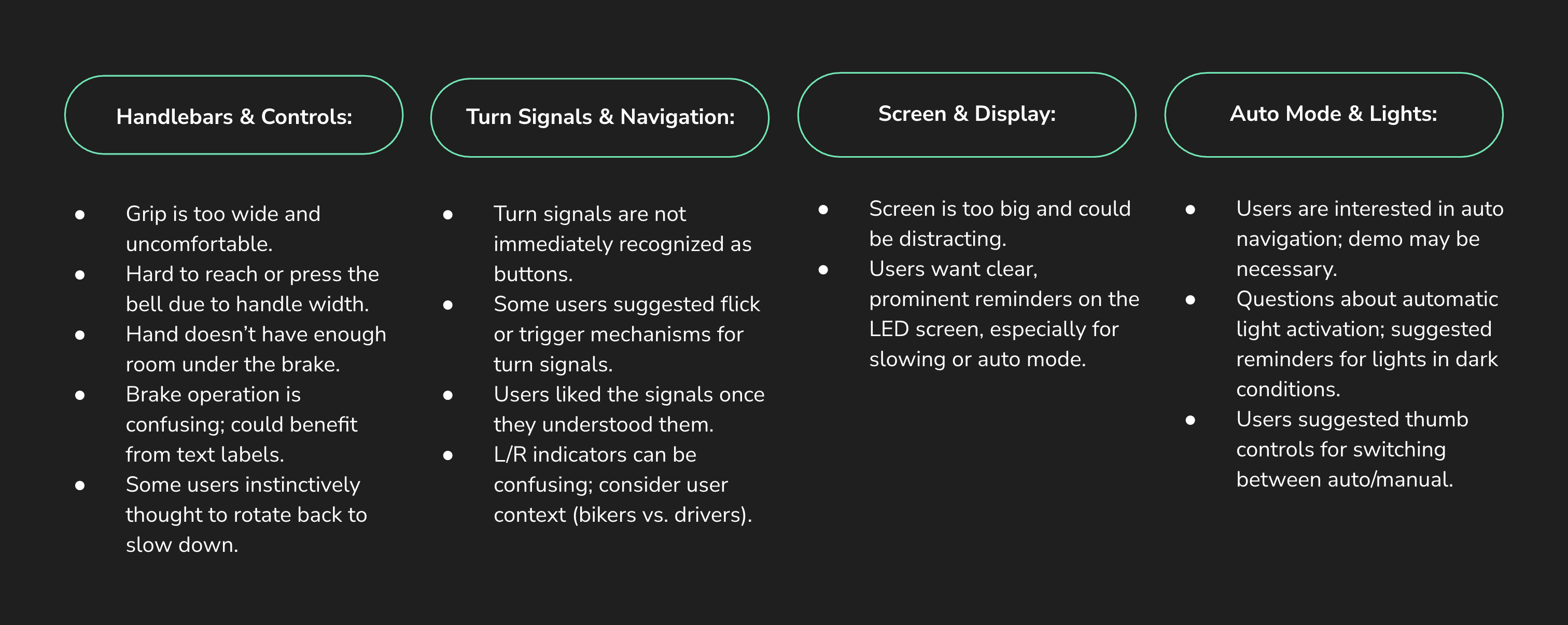
Testing Feedback Results
Key findings and insights from our user testing sessions
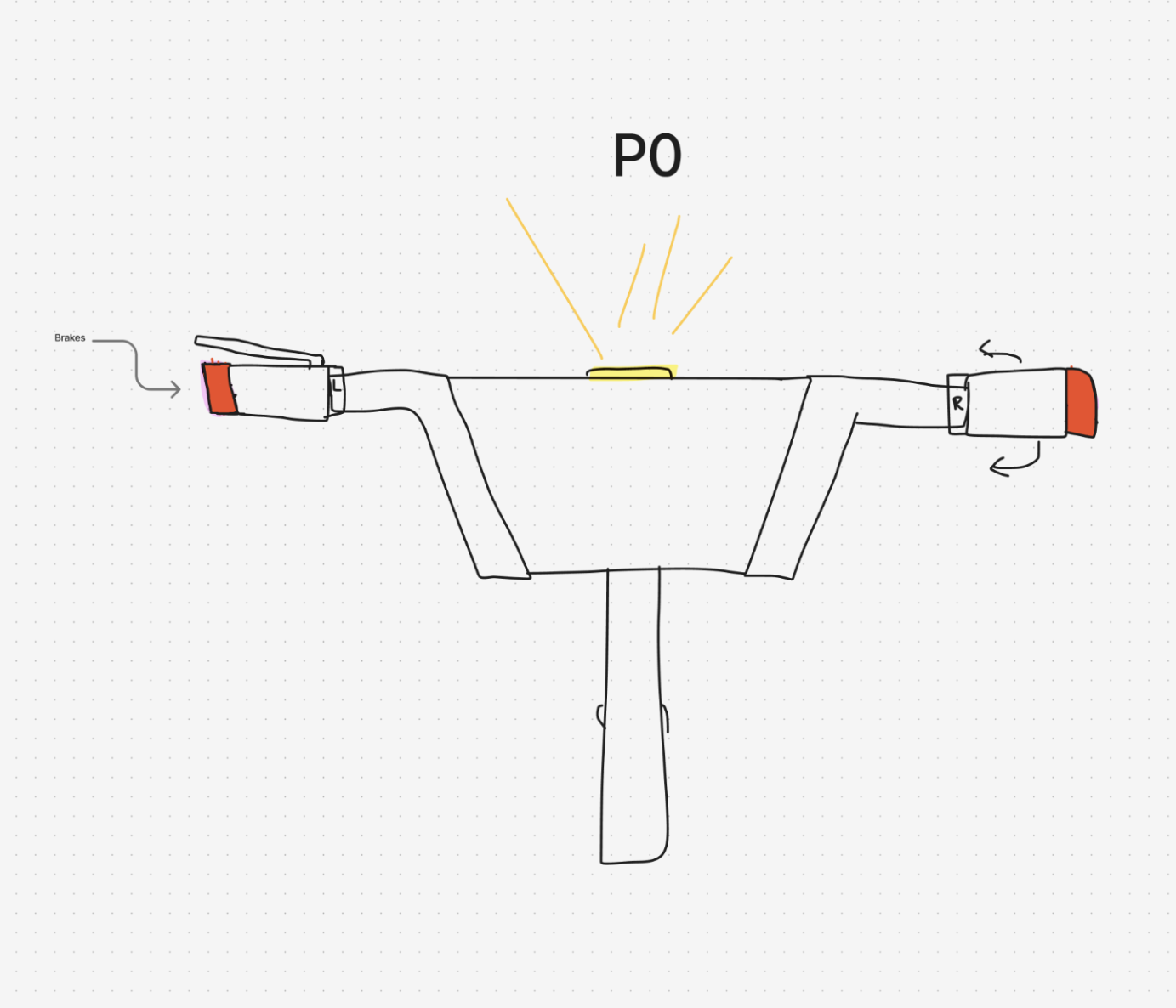
Iteration
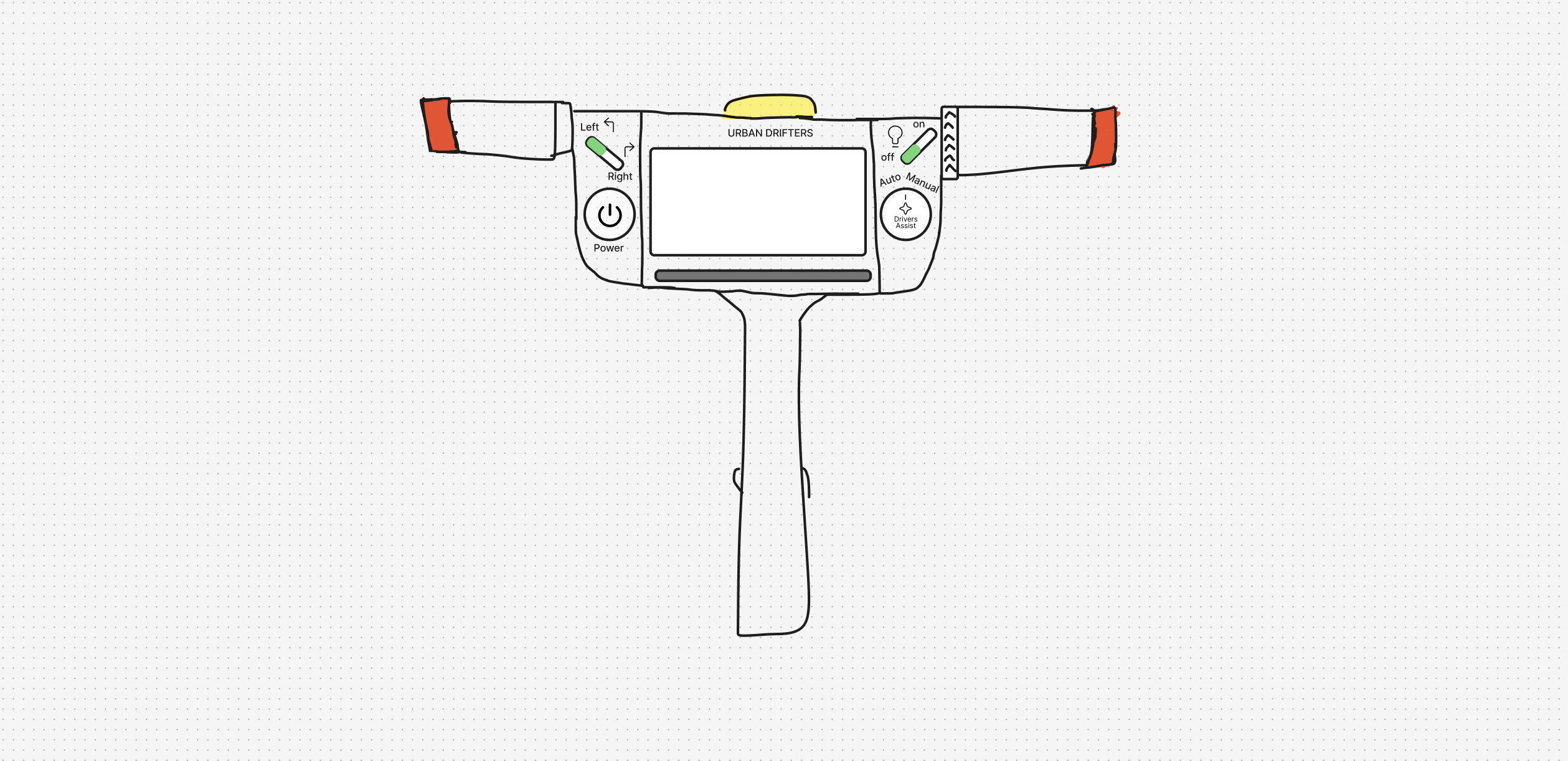
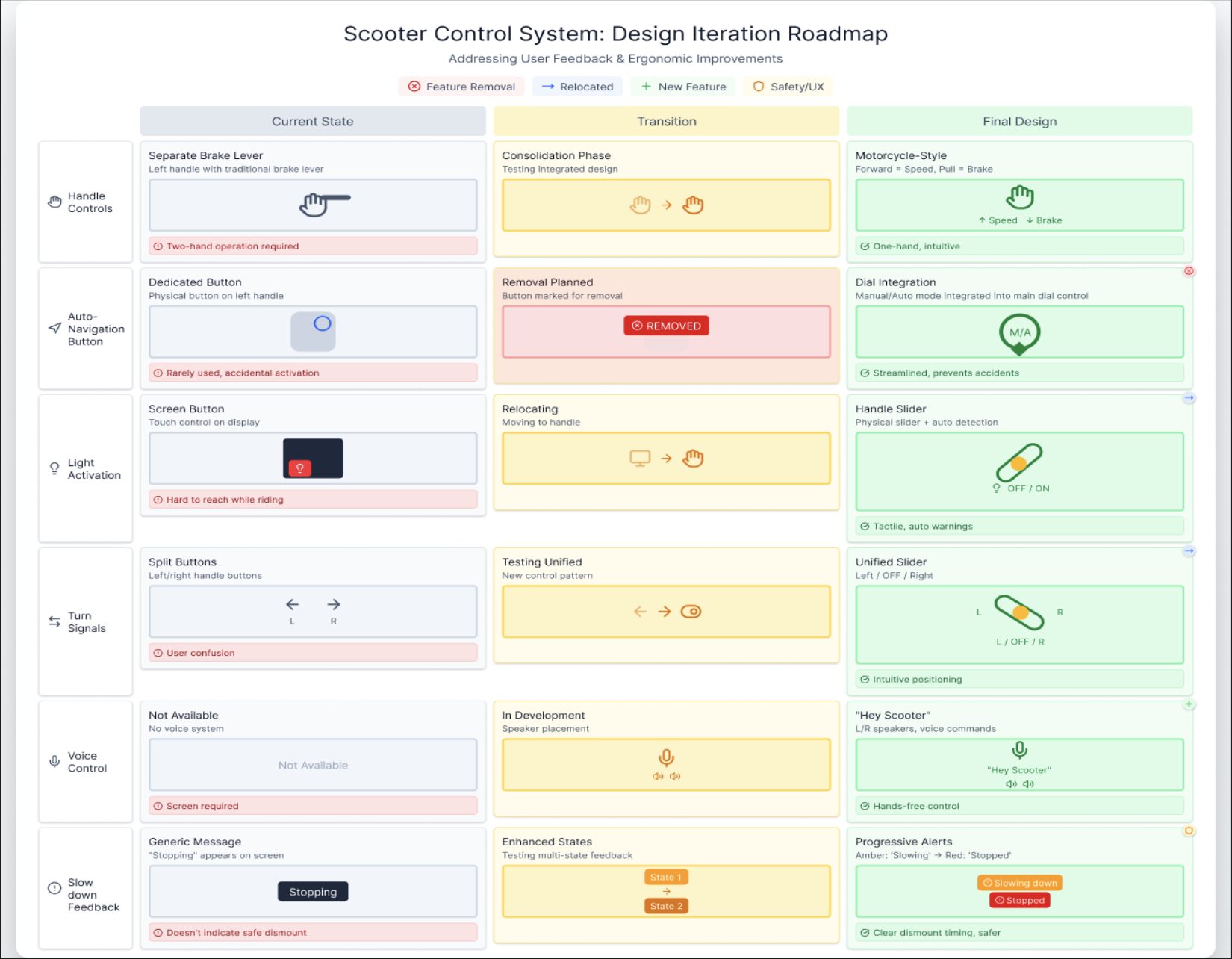
After identifying the key changes needed to improve user interactions with our prototype, I created an improved sketch to pre-plan and visualize the new interface. These changes were consolidated into our roadmap, showing the updated profile sketch and key modifications made.
Design Decisions & Rationale
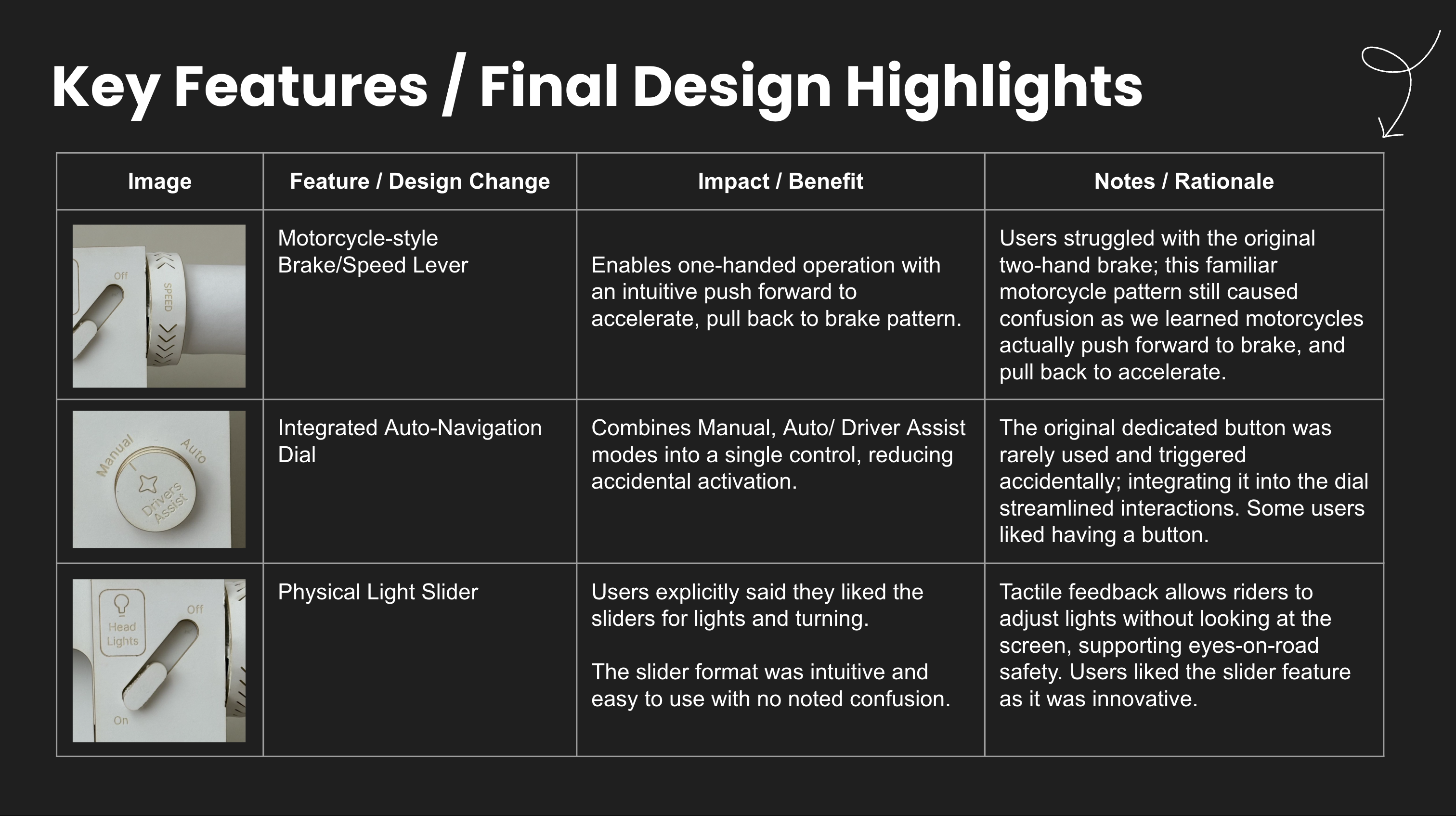
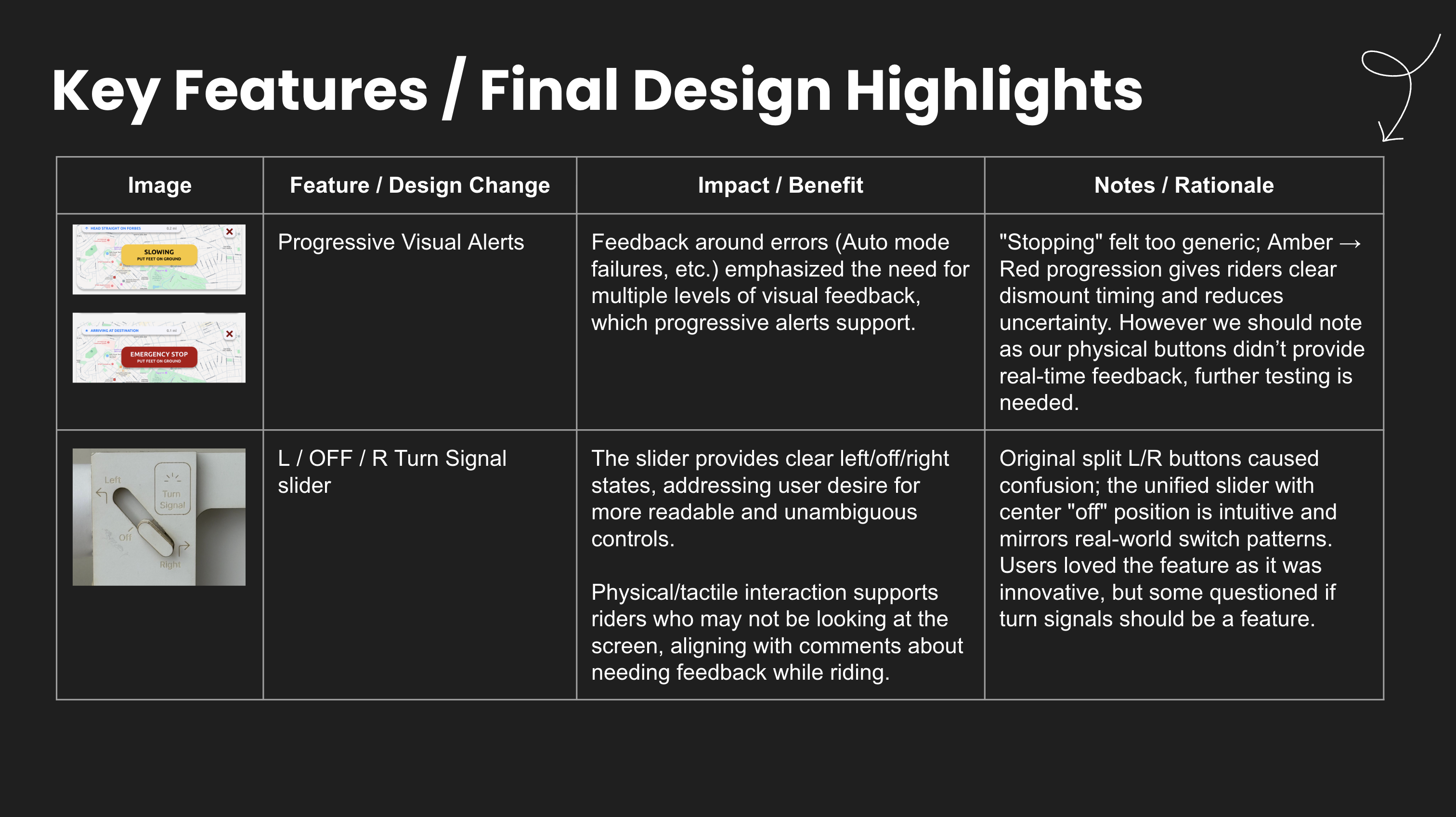
An overview of our key design choices, the trade-offs we considered, and how user feedback influenced our final solution.
Why we redesigned:
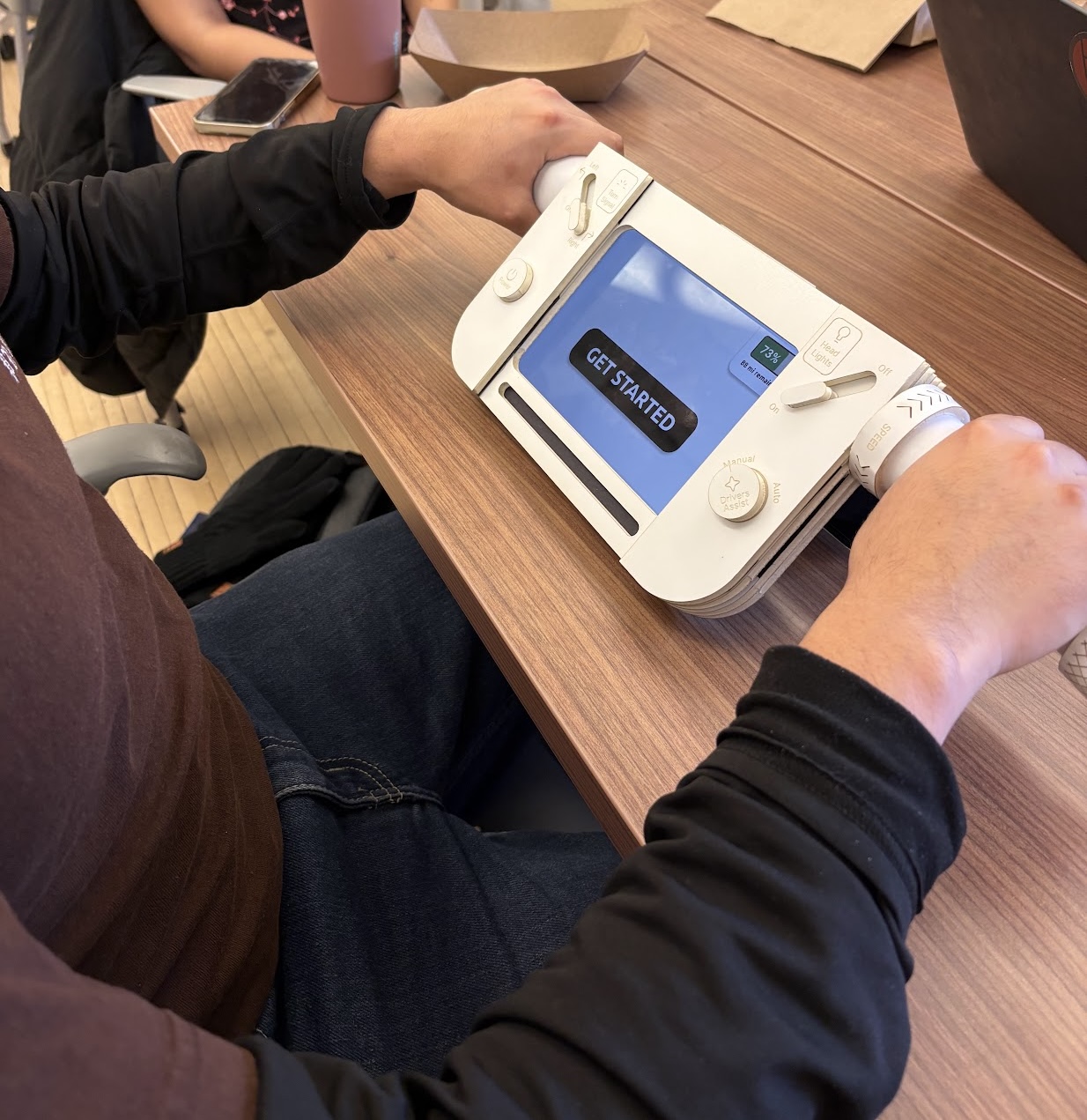
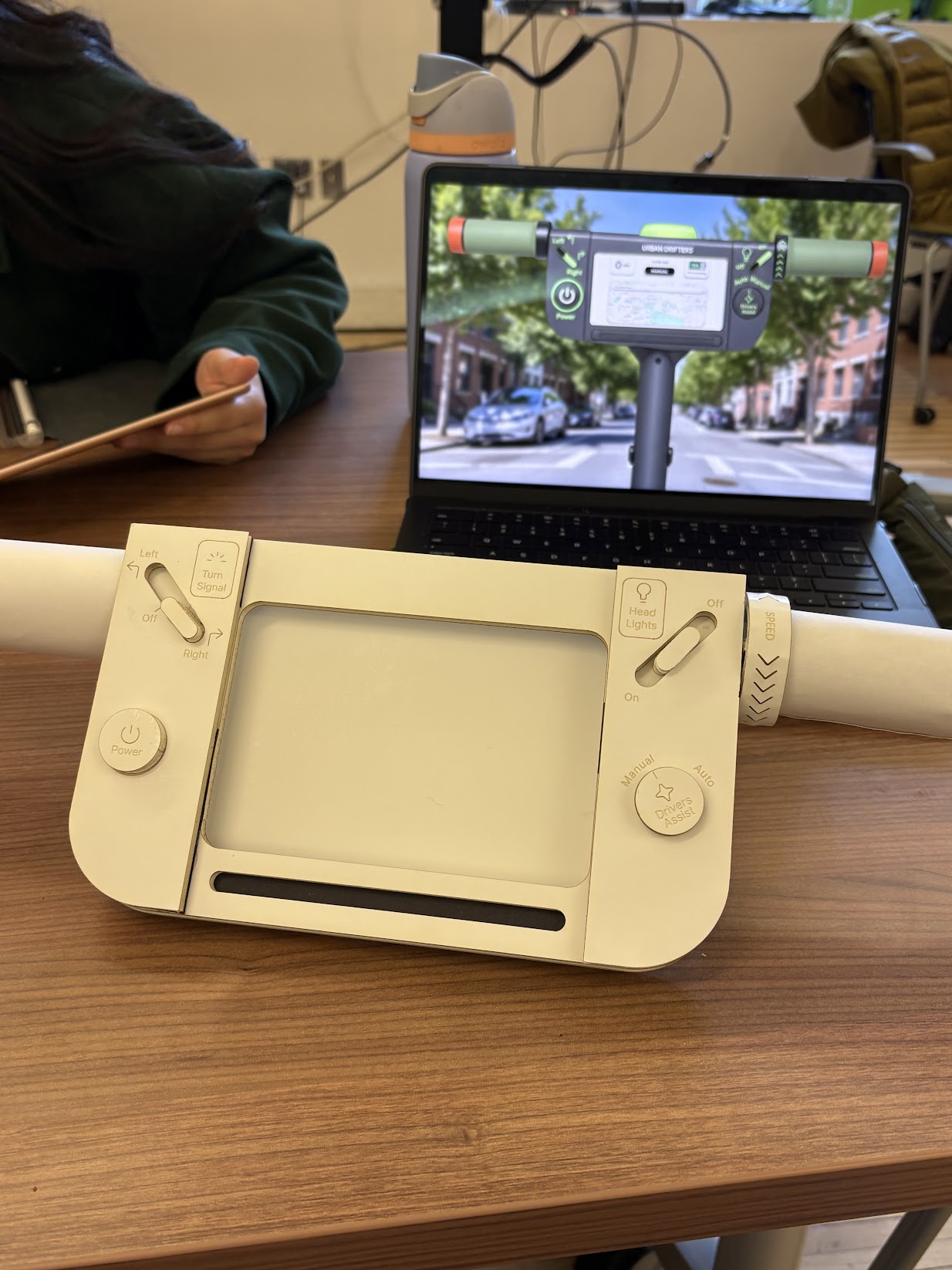
We consolidated controls to enable one-handed operation, replacing the separate brake lever with a motorcycle-style grip, integrating auto-navigation into the main dial, & unifying turn signals into a single L/OFF/R slider.
Trade-offs considered:
Simplifying controls improved usability but required additional testing to ensure new patterns were discoverable; adding voice control ("Hey Scooter") increased hands-free capability but introduced development complexity.
How feedback shaped decisions:
Users struggled with two-hand brake operation & accidentally triggered the auto-nav button, so we merged functions; "Stopping" felt too generic, so we added progressive alerts (Amber → Red) for clearer dismount timing.
Final Design
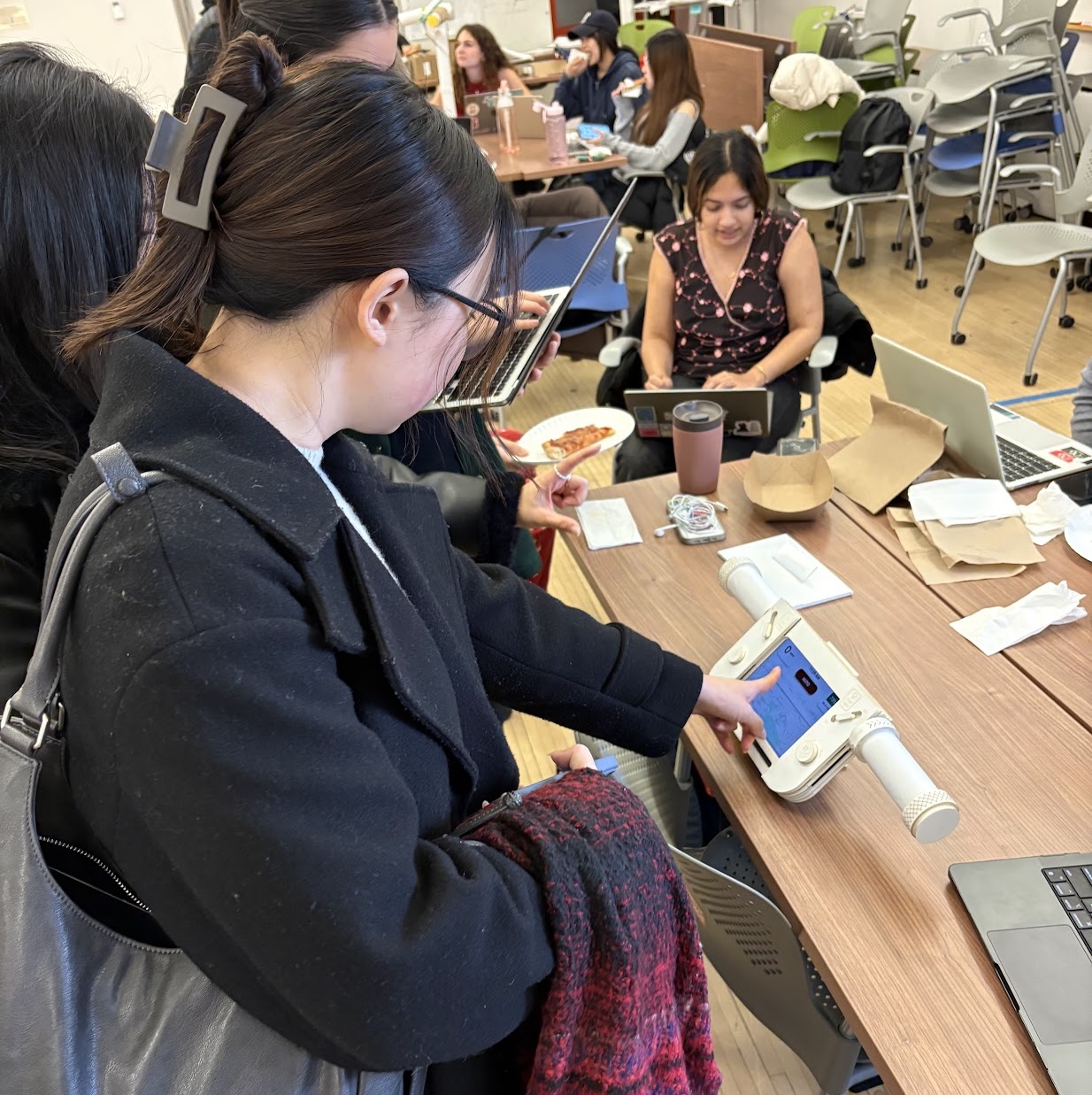
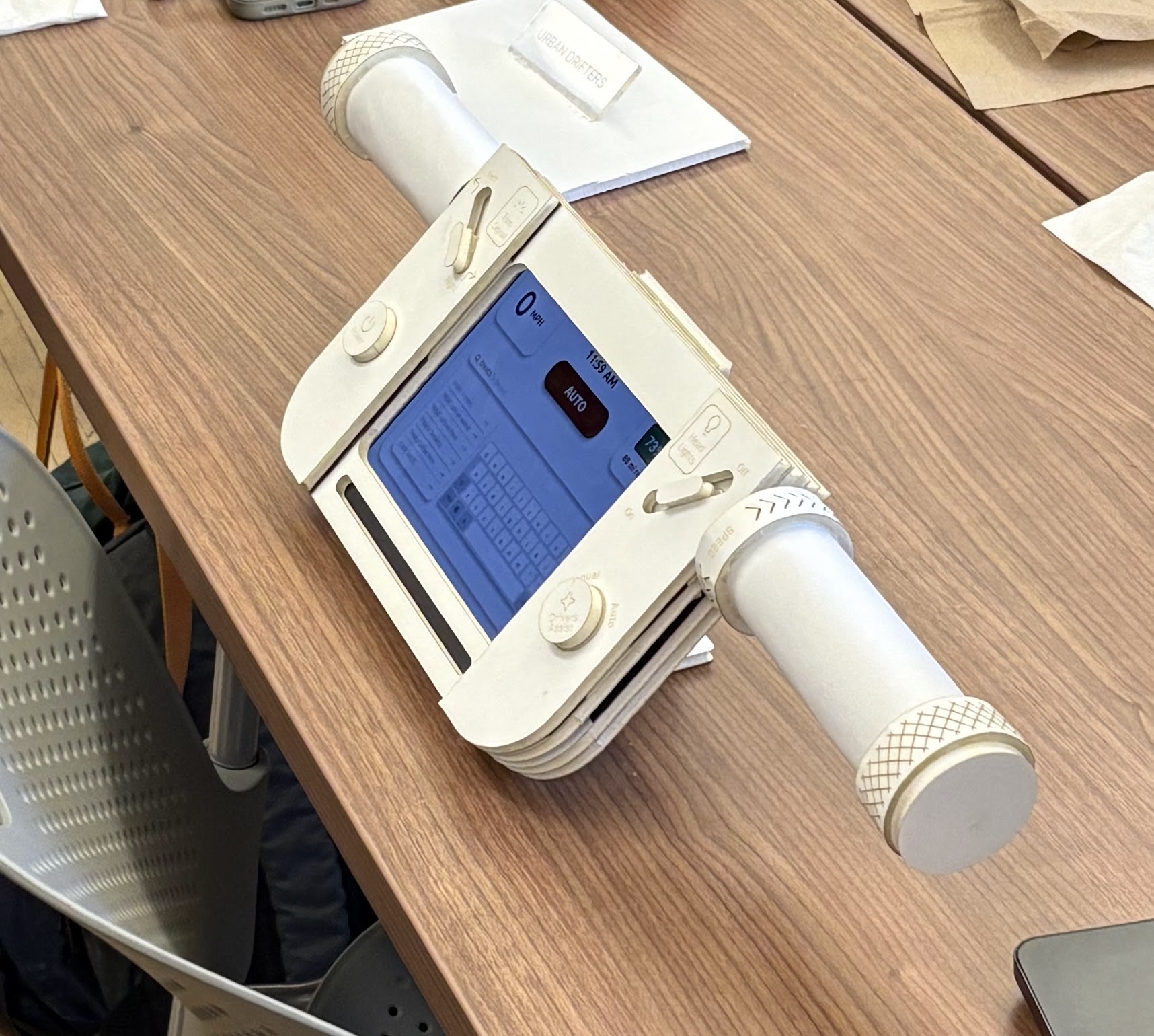
The completed scooter design showcasing the integrated physical and digital control system.
Final Reflection
Through designing the physical and digital interfaces for an electric scooter, I learned the importance of a unified vision to meet user needs and reduce barriers to entry. User research revealed that expectations are often shaped by prior experiences with similar electric vehicles, which guided our design decisions. Rather than prioritizing novelty, we focused on familiar, recognizable interactions to support safety and usability in a high-stakes product. Maintaining a clear relationship between physical and digital controls; such as pairing physical braking with digital confirmation; proved essential for effective feedback. Overall, this project reinforced the value of designing through relational experiences, clear team communication, and iterative prototyping, lessons I will carry forward into future product design work.
More Projects
Check out my other work